Shockwave therapy feels uncomfortable rather than painful for most people.
It’s a strong, rhythmic tapping, closer to a fast series of firm knocks than anything sharp or burning, and the intensity builds gradually from a low starting point at the first pulse.
Worrying that a machine firing pulses into an already painful tendon or heel will make things worse is a fair concern to have, especially when the problem has already dragged on for months despite rest and stretching.
That’s why we’re here to reassure you about the treatment.
Conditions we treat with shockwave therapy every week at Active Health Clinic Glasgow include plantar fasciitis, Achilles tendinopathy, tennis elbow and patellar tendinopathy.
Shockwave sits alongside physiotherapy as one of several musculoskeletal treatments we offer.
We control the intensity throughout so you’re never dealing with more than you can manage, and our physiotherapists listen to your concerns before starting to ensure you feel comfortable throughout.
What shockwave treatment feels like
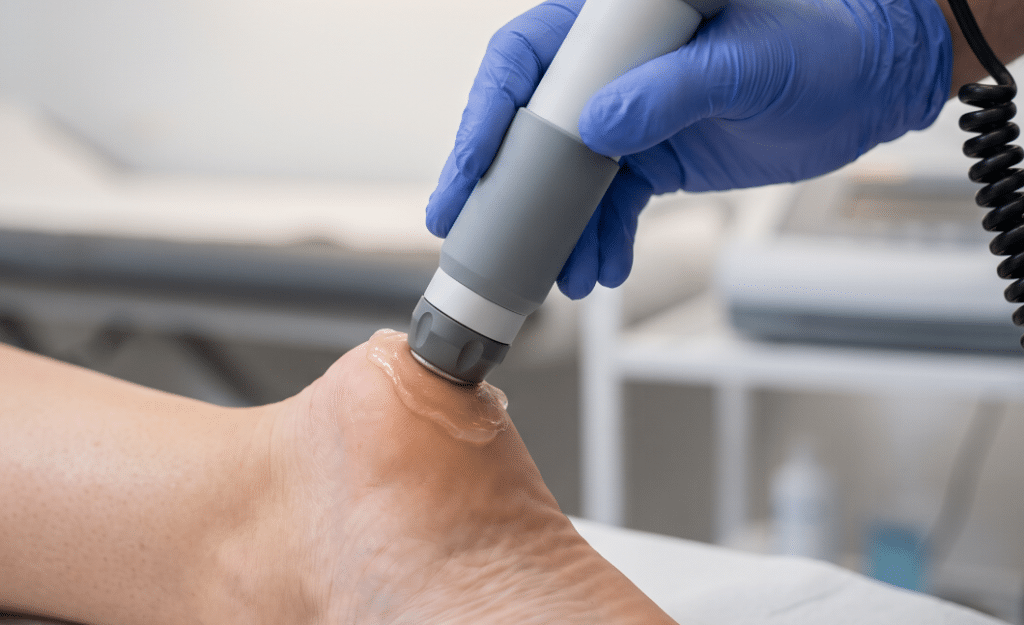
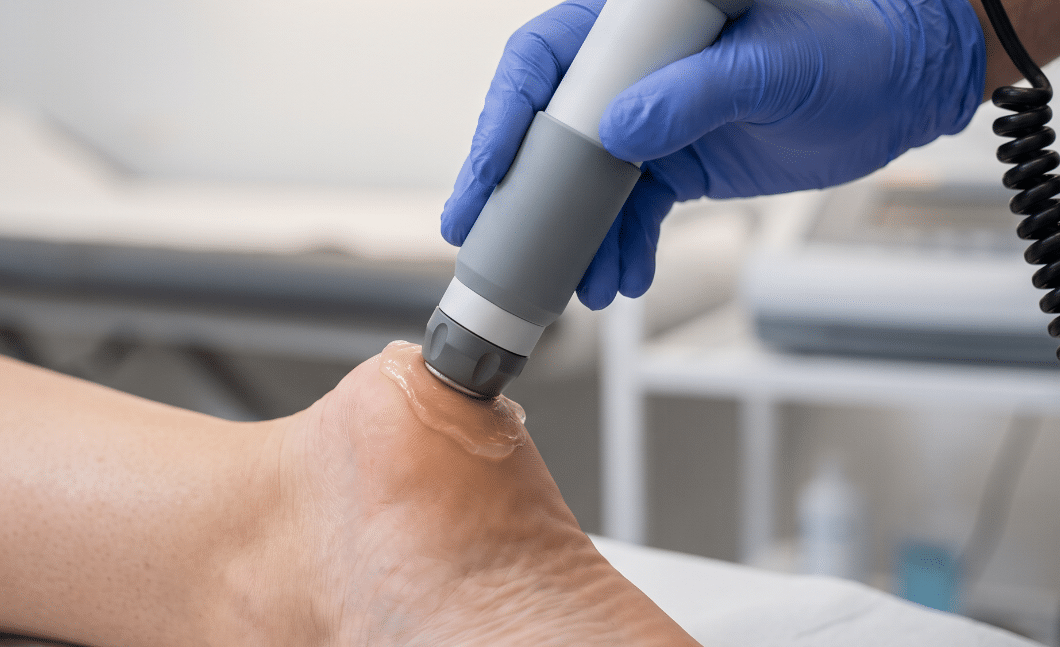
The shockwave device sends short pulses of compressed air through a handheld applicator, and each pulse produces a distinct tapping or pulsing sensation as it’s passed through the skin.
It comes across as a rapid, blunt knock, closer to a firm tap than a jab.
An ultrasound gel is applied to the skin first, which helps the sound waves transfer cleanly into the tissue below.
The applicator then moves across the affected area for the length of the session, and you’ll feel that tapping the whole time it’s in contact with your skin.
The sensation eases as the applicator keeps moving, and your nerve endings adjust to the steady rhythm within moments.
Ask us to slow down or pause at any point, and we will immediately, though most people settle in quickly and don’t need to.
Where shockwave therapy feels stronger
Body parts with less skin and muscle over them, like the heel in plantar fasciitis or the outer elbow in tennis elbow, transmit more of each pulse directly to the nerve endings underneath.
How much you feel varies depending on the area as well as from one patient to the next, which is why we always reassure our patients to tell us any time they need a break or a lighter intensity.
Achilles tendinopathy and patellar tendinopathy
Achilles tendinopathy sits in a similar spot.
The tendon runs close to the surface with little cushioning around it, so patients often notice more sensation there than they do over a fleshier area like the shoulder or hip.
Patellar tendinopathy, just below the kneecap, tends to fall somewhere in the middle.
The soft tissue and ligament structures around the knee offer a bit more give than bare tendon over bone, though it’s still a sensitive spot for most people.
How we control ESWT intensity
Every shockwave machine lets the physiotherapist adjust the energy level delivered with each pulse, so we start low and build up gradually across the session as your body adjusts.
Starting low and building gradually stimulates blood flow and triggers the healing response, and your physiotherapist keeps raising the level only as far as you’re comfortable with.
Our clinic uses radial shockwave therapy, which spreads energy across a broader part of the treatment area rather than concentrating it at a single depth.
Radial shockwave also suits the calcification and scar tissue we’re most often trying to break down in chronic tendon problems.
Shockwave therapy, known as extracorporeal shockwave therapy or ESWT in full, is a non-invasive treatment for musculoskeletal conditions: no needle, no incision, and no anaesthetic required at any stage.
It sits alongside injection therapy as an effective treatment option once conservative treatment like rest, stretching and load management hasn’t shifted a stubborn tendon problem on its own.
What we check before your session
Anti-inflammatory drugs blunt the exact response shockwave therapy is designed to trigger, so if you’re currently taking ibuprofen or another non-steroidal anti-inflammatory, let us know at assessment.
Depending on your situation, that might mean adjusting the treatment plan or exploring an alternative.
We always check your medical history at assessment, before the machine is ever switched on.
Recent steroid injections in the treated area, blood clotting disorders, and active infection all change whether shockwave is the right call for your injured tissue right now, and we’d rather catch that early than partway through a course.
What’s normal afterwards
Mild discomfort, a small bruise or a patch of redness around the treated area is common for a day or so after your appointment.
Soreness, bruising or redness like this doesn’t usually stop you from getting on with normal daily activities straight away, so most people head back to their desk or out for a walk the same day.
A typical treatment plan runs to three sessions spaced roughly a week apart, though some tendon injuries need extra sessions depending on the severity.
Pain relief tends to build gradually over time, with a real reduction in pain often showing over six to 12 weeks as the healing process catches up with sports injuries or overuse problems underneath.
If you’re managing a stubborn case of heel or foot pain or ongoing elbow pain, it is important not to expect the first session to fix things outright.
Most of the change happens in the weeks between sessions, while the tissue rebuilds itself.
We will guide you on your exercise and aftercare plan so you know what to expect.
Questions about shockwave therapy, answered
How many shockwave therapy sessions will I need?
Most courses run to three to six sessions, and your physiotherapist recommends the most suitable treatment plan once they’ve assessed your specific injury.
Is shockwave therapy suitable for everyone?
We check whether shockwave therapy is appropriate for you at assessment first, since it suits a wide range of conditions but isn’t right for everyone. It isn’t used during pregnancy, over certain metal implants, or where there’s an active infection or clotting disorder in the treated area.
How soon does shockwave therapy work?
Some patients notice a difference within a couple of sessions, though full pain relief usually takes longer to settle in. The treatment stimulates your body’s own repair process, which takes weeks to complete, so expect steady, small improvements building up with each session before significant pain relief settles in.
Is shockwave therapy safe?
Yes. Shockwave therapy is a safe, well-established treatment with minimal reported side effects beyond short-term soreness or bruising. If you’ve got questions about shockwave therapy specific to your own injury, we’re happy to talk it through before you commit to a course.
Book your shockwave therapy assessment with Active Health Clinic
There is a huge amount of benefits to undergoing shockwave treatment.
The discomfort you’ll feel during a session is manageable, and it’s over within about fifteen to twenty minutes each time.
A tendon problem left untreated can drag on for months without improving on its own. A handful of fifteen to twenty minute sessions gets a stalled tendon moving again, whether that means getting back to running, training, or just walking without wincing.
Book online or call us on 07427 737 604, and we’ll talk you through exactly what to expect before you decide whether shockwave therapy is right for you.
Book Your Appointment
Ready to take the next step? Book your appointment today or call us on 07427 737 604. We’re here to help with tailored, evidence-based care.