
Desk-based back pain is stubborn. Stretching can loosen muscles for a while, but it alone doesn’t build the strength that stops the ache coming back day after day.
Back strengthening exercises target the muscles holding your spine, hips and core steady through the day, from the moment you get up to the last time you bend to untie your shoes.
Get the right ones into a weekly routine and they build a back that copes better with lifting, sport and long stretches sitting still.
What a stronger back protects – By Glasgow’s team of physiotherapists
A weak back isn’t only a lower back problem.
The muscles supporting your spine run from your shoulder blades through your core down into your hips, and when the muscles in your back go soft, your hip flexors and hamstrings pick up jobs they were never built for.
Hip weakness and a soft core are a common cause of back pain that otherwise seems to come from nowhere. Building strength there stops it becoming a repeat problem.
Build strength through the muscles of your back and hips together, not in isolation. Your lower back stops absorbing loads it shouldn’t, and your upper body moves with a stability that stretching alone never delivers.
Strength and flexibility both matter here, and training only one leaves your back only partly protected.
Get the basics right before you start
Good form is what makes each exercise effective.
Most of them start lying on your back or on all fours, asking you to keep your back straight, or flat against the floor, rather than arching or rounding.
Set your feet flat on the floor.
Brace your abdominal muscles gently, and keep your spinal position neutral rather than forced flat or arched.
If you have a history of back injury, or you’re ever unsure whether a movement is right for your spine, one of our chartered physiotherapists can check your form and adapt the exercises to your specific back.
And if you feel sharp pain, or pain that shoots down a leg during a movement, stop.
Sharp pain isn’t a range of motion you should work through on your own.
It’s always worth getting assessed before starting a new exercise routine.
Exercises that build real back strength
The following exercises can help build genuine strength across both upper and lower sections of your back, plus the hips and core that support them.
The most important thing is consistency.
Gradually build up a routine with one or two of the exercises before adding more to your workout.
Two or three sessions a week is enough, with a rest day in between while your muscles adapt.
Glute bridge
Lie on your back with your knees bent and feet flat on the floor, hip-width apart.
Squeeze your buttocks and lift your hips toward the ceiling until your body forms a straight line from your knees to your shoulders, then lower slowly back to the starting position.
This one works your glutes and lower back together, a pairing that’s easy to lose after long hours sitting down.
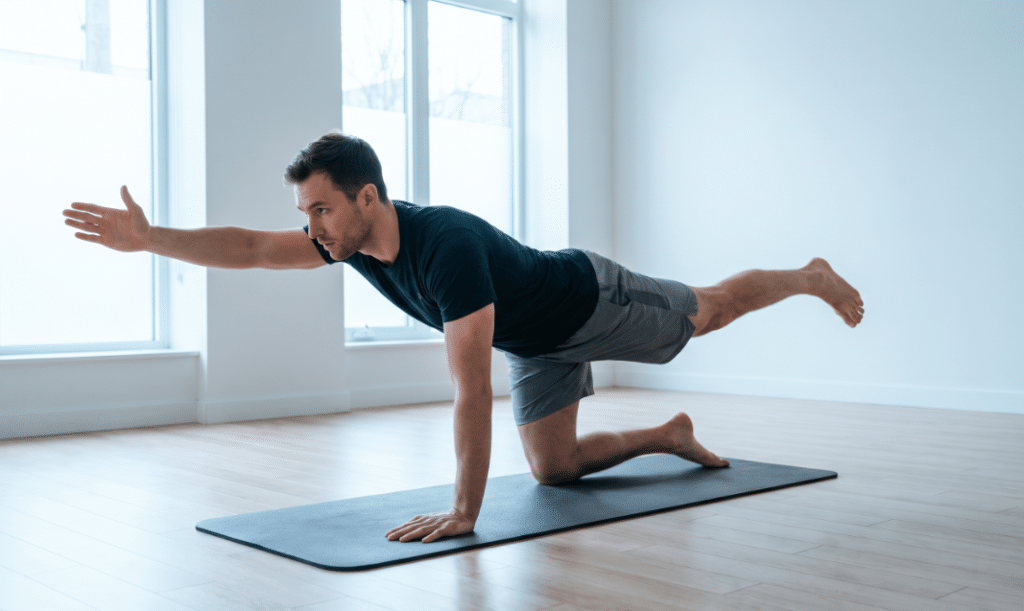
Bird dog
From kneeling on all fours, extend your right leg straight behind you while reaching the opposite arm forward.
Keep your hips and knees square and aim to form a straight line from fingertips to toes.
Hold for a couple of seconds, return to the starting position, then switch sides.
The bird dog trains your core muscles to hold your spine steady while your limbs move independently, which mirrors how your back gets used through an ordinary day.
Back extension
Lying face down, arms by your sides, lift your chest a few inches off the floor by squeezing your lower back muscles, then return to the starting position under control.
Keep the movement small.
This exercise teaches the muscles on either side of your spine to fire on demand through small, controlled lifts. That control supports recovery from lower back pain.
Plank
Support your weight on your forearms and toes, pull your navel gently toward your spine, and hold a straight line from shoulders through hips to heels.
Hold thirty seconds properly, with your lower abdominals working hard and your hips level, rather than let your form break down over a longer hold.
Building that kind of core endurance protects your back during everything from carrying shopping to a long car journey.

Hip hinge
Standing with knees slightly bent, hinge at your hips and send your hips back while keeping your back straight and your chest reaching forward, almost like closing a car door with your bottom.
Flatten your back and keep your knees bent throughout, rather than letting it round as you lower.
Master this pattern with just your bodyweight before you ever pick anything heavy off the floor. A resistance band looped around your hips adds useful feedback once the movement feels natural.
Row and shoulder squeeze
The upper back muscles between your shoulder blades are easy to skip when back training focuses only on the lower back, and skipping them leaves you stronger below the belt while you still round forward at a desk.
Bend your elbow to roughly ninety degrees, draw both arms back and squeeze your shoulder blades together as though pinching a pencil between them, hold briefly, then release.
Do it with a resistance band anchored at chest height, or without any equipment at all.
Either way, this single movement retrains your posture directly, instead of relying on reminders to sit up straight.
Treating back pain that keeps coming back
One or two sessions won’t shift chronic low back pain, and nobody should expect them to.
Regular, targeted strengthening work is central to easing chronic back pain, and the improvement tends to hold up over time.
The same principle holds for both specific back pain, where there’s a clear cause, and non-specific low back pain, where scans come back unremarkable and the pain still won’t shift.
Sticking with a strengthening routine over several weeks is what changes chronic low back pain for our patients.
Patients with a long history of flare-ups often need more than a page like this one can give.
We build spinal stabilisation exercises around your specific pattern of pain as part of our back pain physiotherapy, adjusting them as you improve.
How to train your back safely
Build up gradually
Build strength gradually by adding a set, a few extra seconds, or one more exercise every week or two, rather than trying to do all six perfectly on day one.
If you’re returning to exercise after time off with a back injury, ease back into these six rather than picking up where you left off.
Ease off, don’t push through.
If a movement leaves pain that lingers rather than the normal muscle fatigue of a decent workout.
Muscle pain the next day is expected, but sharp pain during the exercise itself isn’t.
It’s your cue to stop and get it looked at rather than push on.
Make it a regular habit
Three short, well-formed sessions a week, kept up for two months, build real strength through your lower back, hips and lower body.
One brutal session followed by a week recovering from doing too much won’t.
People managing a sedentary lifestyle usually have the most room to improve, simply because they’re starting from so little baseline strength.
Anyone returning to exercise after an injury, a period of pain, or a long time out of the gym should build these exercises in gradually and get individual guidance from a physiotherapist or doctor on pacing a return to activity safely.
Back Strengthening Exercises FAQs
How do you strengthen a weak back?
Start with bodyweight strength exercises that train your back and hips together, such as the glute bridge, bird dog and hip hinge, done two to three times a week. Build load and difficulty gradually rather than jumping straight to weights.
What are the big three exercises for the back?
The hip hinge, the bird dog and the plank cover the three movement patterns your back relies on most. Together they train you to hinge safely, stabilise your spine while you move, and hold a strong core under load.
Does strengthening your back muscles improve posture?
Yes, particularly exercises for your upper back and shoulder blades. Weak upper back muscles let your shoulders round forward, so strengthening them, alongside your core, makes it far easier to sit and stand tall without consciously correcting yourself all day.
Who needs to focus most on lower back strength?
Anyone with a desk job, anyone managing a history of back pain, and anyone returning to sport or heavy lifting after time off.
How do I know if I’m strengthening my back safely?
You should feel muscle fatigue during and shortly after exercise, rather than sharp pain or pain running down a leg. If you ever experience any pain like that, or you’re unsure whether an exercise suits your specific back, speak to one of our physiotherapists before continuing.
Ready to build a back that holds up?
These exercises work best when they’re tailored to your back.
Our chartered physiotherapists take the time to assess how your spine, hips and core are working together, then build you a rehab plan around what your back needs, whether that’s a first flare-up or a problem you’ve carried for years.
Book an assessment online or call us on 07427 737 604, and we’ll get you started on exercises that are right for your back.
Book Your Appointment
Ready to take the next step? Book your appointment today or call us on 07427 737 604. We’re here to help with tailored, evidence-based care.