If you’re booking your first shockwave session, you probably want to know two things: what the machine does, and whether it’s safe.
The name causes most of the confusion.
Shockwave doesn’t involve an electric shock. “Shock” describes the mechanical pressure wave delivered through the skin, not an electrical current passing through your body.
This guide covers what’s inside the machine itself, the standards it has to meet, and why we brought this equipment into the clinic to help improve our patient’s lives.
Inside our shockwave therapy machine
Inside the handpiece
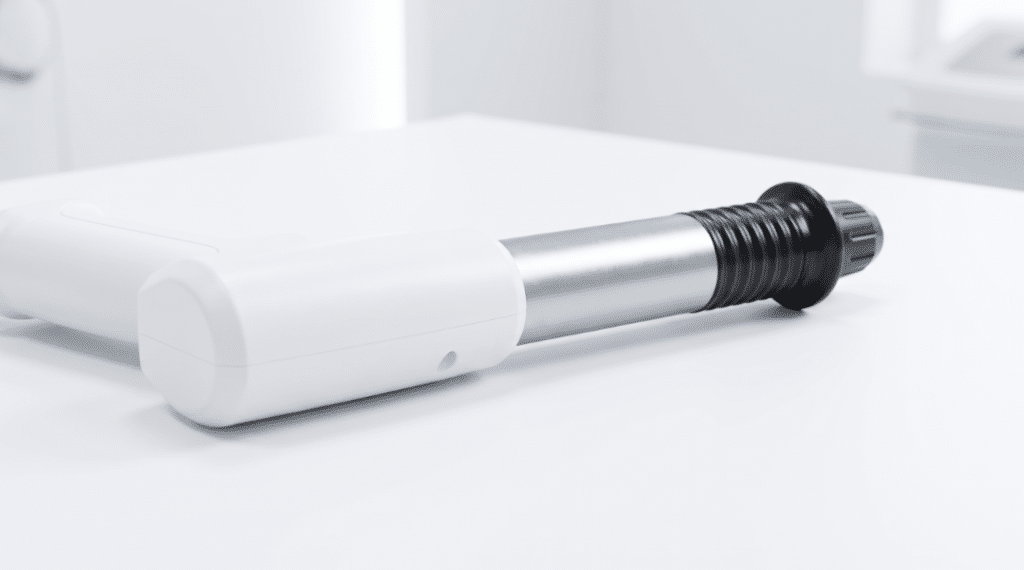
The machine sits on a small trolley beside the treatment couch, connected by a cable to a handpiece about the size of a large torch.
Inside it, a compressor drives a metal projectile back and forth at speed.
Each strike against the tip of the applicator sends an acoustic pressure wave, a burst of high-energy sound waves, through the skin into the tissue underneath.
Manufacturers call this the radial design, or radial pressure wave therapy, because the wave spreads across a wider area at shallower depth rather than concentrating on one exact point.
That spread suits tendon and soft tissue injuries near the surface, whether that’s a heel, an elbow or a shoulder.
How the pulses reach the tissue
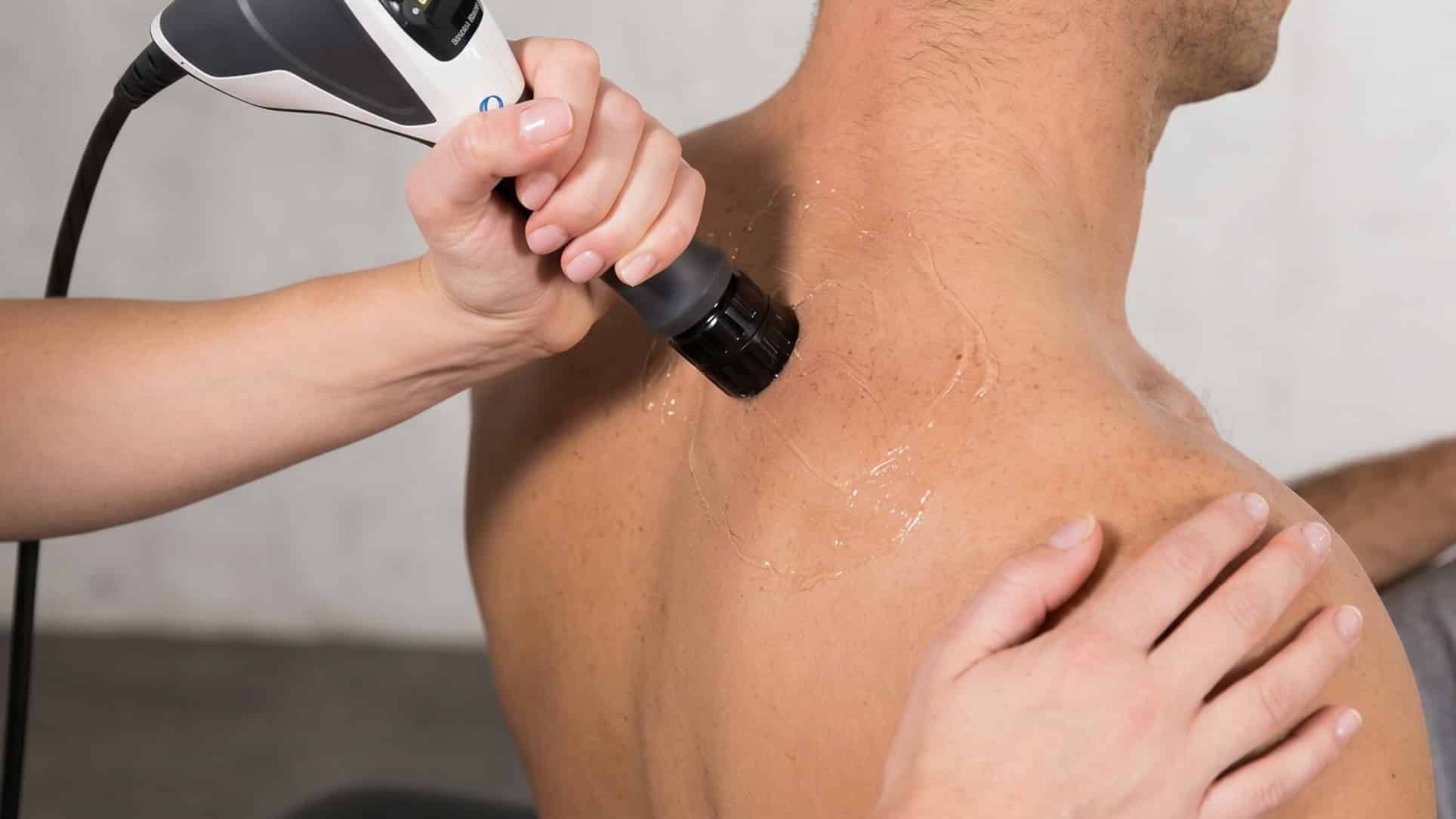
The therapist moves the handpiece across the treatment area throughout the session rather than holding it in one spot, so the energy covers the whole affected zone rather than a single point.
The treatment involves no needle, no incision, and no injection at any point.
The applicator sits on the skin with a thin layer of gel underneath it, the same conductive gel used for scans elsewhere in medicine, and the pulses travel through that gel into the tissue.
You’ll feel a firm, rhythmic tapping rather than anything sharp, and the therapist adjusts the intensity based on how you’re finding it.
Radial vs focused shockwave equipment, and why it matters to you
Shockwave equipment comes in two types, focused and radial, and the choice changes what a machine treats well.
Focused shockwave equipment typically uses an electromagnetic mechanism to concentrate its energy at a precise focal zone and depth. This is useful for reaching deeper structures with pinpoint accuracy and greater penetration.
Radial equipment, the type we use, spreads energy across a broader area closer to the surface.
For the musculoskeletal conditions that bring most people through our door, plantar fasciitis, tennis elbow, Achilles tendinopathy and patellar tendinopathy, radial suits the job better than focused would.
These are surface-level tendon and soft tissue problems spread across an area rather than concentrated at one point, so a wider pressure wave treats the whole affected zone in a single pass instead of chasing one spot.
The safety standards our shockwave therapy machine meets
Certification and calibration
Any shockwave machine used on patients in the UK has to carry a CE mark or UKCA mark as a certified medical device.
That certification means it’s been independently assessed against safety and performance standards before it can be sold for clinical use at all. It covers the electrical safety of the unit, the calibration of the pressure output, and the manufacturing consistency of every handpiece that ships.
A machine delivering pressure waves at the wrong intensity either does nothing useful or risks bruising and tissue damage, so the output has to stay accurate across thousands of pulses in a session and thousands of sessions over its working life.
We check ours as part of routine maintenance rather than assuming a reading on the display is automatically correct.
Hygiene between patients
The applicator head touches bare skin, so it gets cleaned between every single patient with clinical disinfectant, and any gel that’s touched skin doesn’t get reused.
It is a step we take seriously at Active Health Clinic.
Why we brought shockwave equipment in-house
Shockwave has become a popular treatment in sports medicine and physiotherapy clinics because it’s a safe, non-invasive treatment for tendonitis and other chronic tendon problems that haven’t responded to rest.
Before this machine arrived, anyone whose tendon pain needed shockwave as a treatment option had to be referred elsewhere.
We understood the need for the machine at our clinic, helping our patients start treatment sooner and stay with the physiotherapist who already knew their case and their injury profile.
One physiotherapist, start to finish
The physiotherapist who diagnosed your plantar fasciitis or your tennis elbow is now the same person who assesses whether shockwave fits your case, delivers the sessions, and adjusts the plan if progress stalls.
Staying with that one physiotherapist means you avoid being handed off to a provider who’s never examined you and won’t be the one managing your recovery afterwards.
Treating more than the tendon
Having the equipment on site also means we can combine a shockwave course with manual therapy, targeted exercise or podiatry input in the same visit, something that’s harder to coordinate when the treatment happens somewhere else entirely.
What this means when you book a session
Booking a shockwave session at Active Health Clinic Glasgow doesn’t require you to remember any of the mechanics above. We just wanted to write this guide for those who may be interested in the mechanisms behind the groundbreaking machine.
Every course still starts with a physiotherapy assessment to confirm shockwave is the right treatment for your specific injury before the machine is switched on.
From there, our physiotherapists will guide you through what to expect from the treatment and how many sessions it may take.
Your shockwave equipment questions
Is the equipment you use different from what’s used privately elsewhere?
Standards are broadly consistent across reputable private clinics because every piece of medical equipment has to meet the same CE or UKCA certification before any clinician can use it on a patient. The meaningful difference between providers usually comes down to whether the equipment is radial or focused, and whether it’s maintained and calibrated properly, rather than one brand of certified equipment being safer than another.
Does the machine hurt or damage the skin?
No. The applicator works through intact skin with gel as a conductive layer, so there’s no cutting and no lasting mark beyond temporary redness or mild bruising in more sensitive areas. We control the intensity throughout your session, so it never goes beyond what you’re comfortable managing.
How is the equipment cleaned between patients?
The applicator head is disinfected after every patient using clinical-grade disinfectant, and gel is never reused between sessions. These equipment-specific steps sit alongside our standard clinic hygiene protocols that apply across every treatment room.
Could the equipment interfere with a pacemaker or metal implant?
We check for pacemakers, certain metal implants and a handful of other conditions at your assessment before shockwave is ever recommended, because the mechanical pressure involved isn’t suitable for everyone. If any of this applies to you, we’ll talk through a different treatment option instead.
Will the equipment be used on the same visit as my assessment?
Usually not on your very first visit. That appointment is for a full physiotherapy assessment to confirm shockwave is the right call for your injury, and treatment typically begins once that diagnosis is settled, sometimes in the same session if everything points clearly toward shockwave being appropriate.
Ready to see the equipment for yourself?
Now you know what’s behind the treatment, the next move is bringing your heel pain, elbow pain or stubborn tendon problem to a proper assessment.
Book online or call us on 07427 737 604, and we’ll tell you honestly whether shockwave is the right fit before you commit to a course.
Book Your Appointment
Ready to take the next step? Book your appointment today or call us on 07427 737 604. We’re here to help with tailored, evidence-based care.