
Surgery fixes the structural problem. Post-surgery physiotherapy, or physical therapy, turns that fix into a joint or muscle you can rely on again, pain-free and at full strength.
Here’s what to expect at your first appointment: the conversation, the physical assessment, your treatment plan, and a few red flags worth knowing about.
The conversation that starts your first physiotherapy appointment
Your physiotherapist starts by asking about the surgery itself, your surgeon’s notes, and any weight-bearing restrictions you’ve been given.
These questions decide what we can safely test in the assessment that follows. They also keep the surgical site protected while we build a full picture of where you’re at.
We’ll ask about your pain levels, your medical history, and what daily activities feel hardest right now. Climbing stairs, sitting at a desk, sleeping through the night, and simply getting dressed all come up here.
Tell us everything, even details that feel minor. Missing a weight-bearing restriction or an old injury can mean building a plan around the wrong assumption.
We’ll also flag what’s normal at this stage and what isn’t, so you’re not left guessing between appointments.
The physical assessment
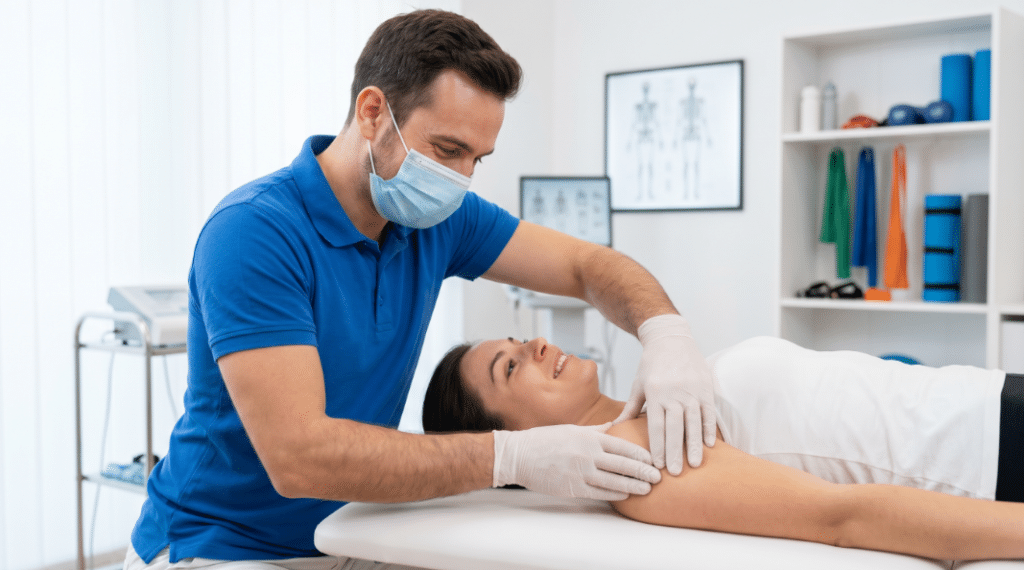
Once we understand your surgery and your goals, the hands-on part of your first session begins. As a patient, you’ll notice we start gently, checking small movements before asking for anything bigger.
We’ll check your range of motion and test muscle strength around the affected area.
We’ll also look at how you’re moving generally, whether that’s your gait, your posture, or how a joint tracks through movement. Joint mobility gets checked alongside strength, since the two rarely recover at the same pace.
Why stiffness and swelling are normal this early
Stiffness and swelling are completely normal this early, and we expect to find both. Soft tissue around the surgical site is often tighter and more sensitive than the joint itself.
What we’re really assessing is how your body is compensating for that. A hip that’s protecting itself often pulls the back and opposite leg out of their normal movement patterns too.
This assessment also flags muscle weakness that surgery alone won’t fix, since strength doesn’t return just because the structural repair has healed.
Your tailored, personalised treatment plan
Everything from the conversation and the assessment feeds into a plan built around your surgery, your goals, and your actual stage of recovery.
Early sessions typically combine gentle manual therapy to manage pain and stiffness with carefully judged exercises to protect the surgical site. A knee replacement or hip replacement needs a different early plan to a ligament repair, and spinal surgery needs different care again.
We customise everything rather than working from a one-size-fits-all script, and joint mobilisation gets introduced only once it’s safe for the tissue involved. This personalised approach means your exercises change as soon as your assessment findings do, whatever week that happens to fall in.
We’ll set milestones together rather than promising a fixed number of weeks. Recovery timelines vary too much between people for a single number to mean much.
If returning to sport is your goal, that shapes the plan from week one, not just the final stretch.

Will physiotherapy after surgery hurt
Some post-surgery discomfort is normal, particularly early on, but a good session shouldn’t leave you in significantly more pain than you started with.
Manual therapy, gentle movement, and sometimes acupuncture or dry needling all help with reducing pain alongside the exercise side of your plan.
Safe movement always comes before pushing for range or strength.
Always tell your physiotherapist if something feels wrong rather than pushing through it. We’ll adjust the next session’s exercises based on exactly what you report.
Red flags that need medical review
Your physiotherapist will tell you which signs and symptoms need faster attention than your next scheduled session.
A handful do, even though most post-surgical discomfort is a normal part of healing.
Tell your physiotherapist or your medical team straight away about a sudden increase in swelling or redness spreading from the wound.
The same goes for a fever, or pain that’s getting worse rather than settling. Numbness, new tingling, or a joint that suddenly feels unstable are worth the same call.
None of this is common. But knowing the signs means you’re never left wondering whether something ordinary is actually worth a call.
What to bring and wear
Wear loose clothing that gives easy access to the surgical site. If you’ve had knee or hip surgery, shorts work better than trousers you’d need to roll up.
Bring any paperwork from your surgeon or hospital, plus a list of your current medication. If you’re using a walking aid, mobility device, or brace, bring it to every appointment, even once you feel steadier without it.
If you’ve had any pre-surgery physiotherapy or advice on preparing for surgery, mention that too. It often shapes how quickly your body responds now.
Early physiotherapy and recovery timelines after surgery
We usually recommend starting physiotherapy before everything feels fully settled, since the exercises and manual therapy support the healing that’s still happening. The right timing still depends on your specific procedure and your surgeon’s guidance.
Some post-operative rehabilitation begins within days of surgery. Other procedures need longer before hands-on treatment starts, and your surgeon’s advice always comes first here.
We work within whatever restrictions they’ve set. That might mean a joint pain flare-up to watch for, or a weight-bearing limit that isn’t ready to be tested yet.
Getting back to full function
The aim throughout is your return to normal function and everyday activities. That might mean back pain that’s finally settled, a joint replacement bedding in properly, or a sports injury fully behind you.
Strength and confidence rebuild at different speeds. You might move well again before you fully trust the joint, and that gap is common.
Mention it at your next appointment if it’s happening to you. Your physiotherapist can add exercises aimed specifically at rebuilding that trust.
Book your post-operative rehabilitation assessment
Every initial session and every follow-up is led by one of our HCPC-registered chartered physiotherapists. That’s expert care registered with the Health and Care Professions Council and the Chartered Society of Physiotherapy.
Our post-operative rehabilitation service at our Glasgow clinic is built around exactly this first-appointment process, whatever surgery brought you to us.
If sport is part of your recovery goal, our sports injury rehabilitation team can pick up where post-operative care leaves off.
Book online or call us on 07427 737 604, and bring your surgeon’s paperwork along to your first session.
Book Your Appointment
Ready to take the next step? Book your appointment today or call us on 07427 737 604. We’re here to help with tailored, evidence-based care.