
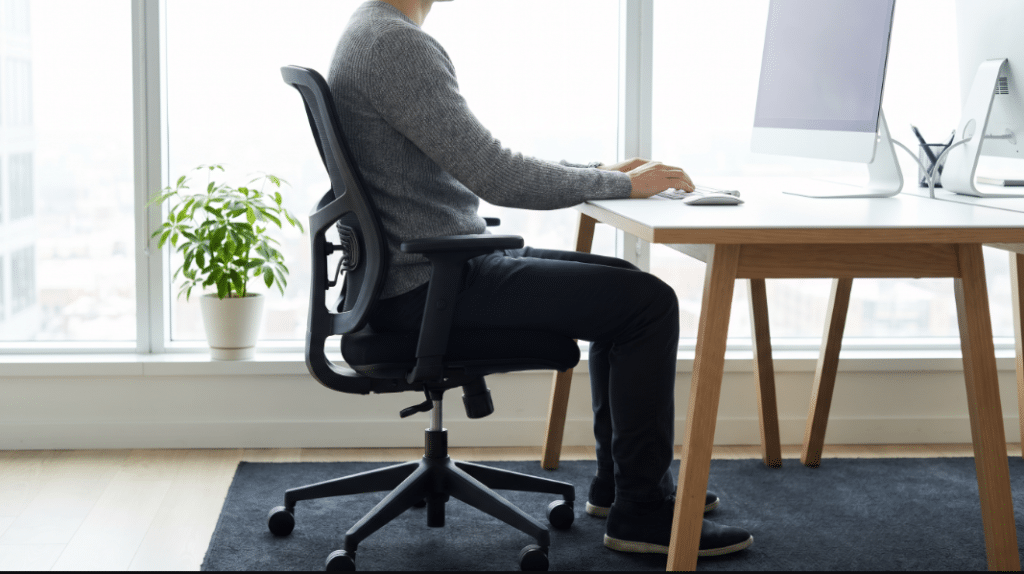
Back pain when sitting comes down to how sitting loads your lower back compared with standing or walking. The lumbar discs, the muscles that support the spine, and the hip flexors all behave differently once you’re seated.
Working out which of them is driving your pain is the first step to fixing it.
The human back is built to move between positions throughout the day. Eight hours in one fixed position is far outside what it’s designed for.
That matters if you sit at a desk, drive for a living, or spend hours anywhere else that keeps you off your feet at a stretch.
Poor posture, disc pressure, weak glutes and an old injury can all play a part, and it’s usually more than one of them working together at once.
Why sitting puts more strain on your lower back than standing – By experienced Glasgow physiotherapists
Your discs take the load
The discs between your lumbar vertebrae act as cushions, spreading pressure evenly through the spine when you stand or walk.
Sit down, particularly if you lean forward or bend towards a screen, and that pressure concentrates on the front of the disc instead.
Classic research on intervertebral disc pressure, going back to Alf Nachemson’s work in the 1960s, found sitting loads the lumbar spine more than standing does. Slouched sitting loads it more again.
Your spine copes worst with holding one static, flexed position for hours, whether you’re at a desk or driving a van across the central belt.
Reclining the backrest slightly and adding proper back support both reduce that disc pressure noticeably compared with sitting bolt upright or leaning forward.
Your muscles switch off
Standing keeps your core and back muscles gently active without you noticing.
Sitting lets them go quiet, and the longer you stay still, the weaker that support gets over the course of the day.
Your hip flexors shorten at the same time, which tilts the pelvis and pulls the lower back into more curve than it needs.
Tired, understretched muscles end up doing a job they’re no longer well positioned to do, and that’s often when muscle pain sets in.
Your spinal column relies on those surrounding muscles for support just as much as the discs themselves, so weak glutes alone can cause back pain, especially once tight hip flexors get added to the mix.
Sitting posture and habits that make it worse
Slouching and a poor sitting position
Rounding your lower back into the seat, or perching forward to peer at a screen, pushes the spine out of its natural alignment.
Sitting in a slouched position for hours overloads the lower back more than almost anything else you do at a desk, and it increases pressure at the base of the spine well beyond what an upright, supported posture creates.
Crossing your legs adds a further twist through the pelvis that plenty of people never notice they’re doing, and it’s rarely just one leg that carries the habit. The urge to bend forward and round through the lower back is exactly the position that overloads the disc most.
Keeping your back straight means finding a relaxed, neutral position between slouching and arching, held loosely and comfortably.
Sitting for long periods without moving
Prolonged sitting, more than any single posture mistake, is what turns mild stiffness into real pain.
Ninety minutes is roughly how long tissue tolerates one position before it starts to protest, whether you’re sitting or standing still in one spot.
Drivers and back-to-back meeting days are particularly rough on the lower back, because there’s rarely a natural point to stand up and reset.
Sitting too long without a break is often the single biggest factor behind pain that seems to come from nowhere.
When it’s more than posture
The causes and treatment approach depend heavily on the type of pain you notice and exactly when it flares, which together are usually the biggest clue to what’s actually going on underneath.
Clinicians use both low back pain and lower back pain interchangeably for the same thing.
Certain sitting positions make the pain worse, and lower back pain when sitting almost always has more than one contributing factor.
Sciatica and disc problems
Sometimes the cause of back pain runs deeper than a poor sitting position.
A herniated disc can press against a nearby spinal nerve, causing sciatica, or nerve pain that extends down through the buttock and leg. It’s often worse with sitting or bending and eased slightly by standing or walking.
Spinal stenosis, a narrowing around the nerves as the spine changes with age, tends to behave the opposite way. Walking and standing aggravate it, while sitting or leaning forward brings relief.
A disc herniation is simply the medical term for what most people call a slipped disc.
Pain while sitting that eases the instant you stand is a classic sign it’s involved, and both patterns need a proper assessment, because the exercises that help one can worsen the other.
What else can cause back pain
Degenerative disc disease, where the discs lose height and cushioning with age, can make sitting uncomfortable even without a specific injury behind it.
This condition is simply a normal part of an ageing spine, common enough that most people show some signs of it by middle age.
Inflammatory conditions such as ankylosing spondylitis are far less common but behave differently again.
Morning pain and stiffness that eases once you start moving is typical of this type of cause.
Muscle strain and spasm
Mechanical back strain, meaning a pulled or overloaded muscle, is behind most non-specific back pain that flares with sitting.
A tight, guarded muscle can cause pain that spreads well beyond where the tightness actually is.
Muscle pain from sitting tends to ease with movement. Nerve pain often doesn’t respond the same way, so how each type reacts to movement helps tell them apart.
Guarded, spasming muscle usually responds well to movement and gentle stretching, plus physical therapy or manual therapy such as dry needling.
Preventing back pain at your desk
Chair, desk and screen height for proper posture
Good posture depends far more on how your desk and chair are set up than on willpower.
If you sit at a desk most of the day, your chair should support the natural curve of your lower back, with your feet flat on the floor and your knees at a right angle.
Your screen wants to sit at eye level so you’re not craning forward, and your forearms should rest level with the desk. This setup needs no expensive kit.
A rolled towel behind the lower back works as well as most branded back support products, and it eases pressure at the base of your spine throughout the day.
A footrest helps if your chair sits too high for your feet to reach the floor properly, since dangling feet pull the pelvis out of a stable, supported position and add strain on your back over a full shift.
Build in proper breaks
Set a timer, take a call standing up, walk to fill the kettle rather than reaching for it from your seat.
Small changes like these help with back pain and prevent back pain from building up again.
Standing desks help most when you alternate between sitting and standing through the day. Parking yourself standing in one new fixed position undoes the benefit just as sitting still does. Anyone doing a work-related injury assessment with us hears this first, because it costs nothing and works fastest.
If your job has you fixed at a screen most of the day, our work-related injury physiotherapy service is built around exactly this problem.
Small, consistent habits help your back and keep your back pain-free more reliably than one big overhaul.
Lower back pain exercises that help
Stretches that relieve the pain
Tight hip flexors and hamstrings pull directly on the lower back, so loosening them matters as much as strengthening it.
A kneeling hip flexor stretch, a seated hamstring stretch, and gentle knee-to-chest rolls all help undo what a day of sitting does to those muscle groups.
Hold each for twenty to thirty seconds, and do them daily. A bit of soreness or pain after starting new exercises is normal and settles within a few days.
These back exercises target the exact muscles that switch off after a day of sitting.
Strength exercises to prevent lower back pain returning
Stretching eases the pain, while strengthening is what stops it coming back. A programme built around your core, glutes and lower back muscles gives the spine the support it’s been missing while those muscles sat idle at a desk.
A tailored plan beats generic back pain exercises off the internet, because the right exercises depend on whether disc pressure, muscle weakness or plain deconditioning is driving the cause of your pain.
Many people combine this with regular deep tissue massage to work through residual muscle tightness while the strength work catches up.
How long it takes to feel a difference
Fixing your setup, breaking up long spells of sitting and staying consistent with stretching usually brings a real change within two to three weeks.
Strength takes longer, closer to six to eight weeks of consistent work before the lower back reliably stops flaring under load.
Pain that hasn’t shifted at all after a few weeks of consistent effort is a sign the cause needs a proper look. Repeating the same routine for longer rarely changes that on its own.
Expect some flare-ups along the way. A few good days followed by a setback is a normal part of tissue settling into new habits, and it happens even when the plan is working.
Recovery is gradual, built from small changes that compound week by week. Mild pain and discomfort after a long day is common early on. Good pain management in these first few weeks comes down to staying consistent with the basics.
Other things that raise your risk
Weight, fitness and sedentary habits
Extra weight through the midsection increases the load your lower back carries in every position, sitting included.
A sedentary lifestyle outside work compounds the problem, since muscles that never get challenged anywhere else won’t cope well with eight hours in a chair either.
General fitness matters just as much as any specific exercise you do. A back that’s used to moving tolerates a bad chair far better than one that isn’t, and that includes the bones and joints that share the load when your posture shifts to compensate.
Old injuries and footwear
Old pain and injury patterns often explain why one person’s back reacts badly to sitting and another’s doesn’t.
An old back or knee injury changes how you sit and stand without you consciously choosing it, often shifting weight unevenly through the pelvis.
Worn or unsupportive footwear does something similar over the course of a day, altering posture long before you sit down at all.
Even something as simple as a foot that rolls inward when you walk can travel all the way up the chain and change how your lower back handles a normal working day.
Old injuries, worn footwear and general fitness rarely cause back pain when sitting on their own, but together they tip the balance for many people whose pain otherwise makes no obvious sense.
When to see a doctor about back pain
Signs that need urgent attention
A dull, constant pain in your lower back that’s worse after sitting than after standing is usually mechanical.
Most back pain from sitting eases with movement, better setup and time.
A smaller number of cases need proper attention sooner. This article isn’t a substitute for medical advice tailored to your specific case. Lower back hurt that only flares with certain positions is rarely a red flag on its own.
See a doctor without delay if you notice numbness around the groin or inner thighs, sudden loss of bladder or bowel control, unexplained weight loss, or fever alongside the pain.
The same goes for pain that started after a significant fall or injury.
Treatment options for everyday back pain
For everything else, and that covers most back pain linked to sitting, an hour-long assessment with a chartered physiotherapist identifies exactly what’s driving the pain so treatment can target the actual cause of back pain.
Over-the-counter pain relievers such as paracetamol or ibuprofen offer pain relief in the short term. But they won’t fix a chair set at the wrong height, or hip flexors that have shortened from months of sitting still.
Anti-inflammatory medication has its place for a short flare, easing the symptom while the underlying cause still needs sorting out separately. It won’t strengthen your lower back or correct the sitting position that’s making the pain worse in the first place.
If your back pain has lasted for weeks with no real improvement, book an assessment online or call us on 07427 737 604.
Come in comfy clothes, and we will work out exactly what’s driving your pain and build a tailored plan around it.
Book Your Appointment
Ready to take the next step? Book your appointment today or call us on 07427 737 604. We’re here to help with tailored, evidence-based care.