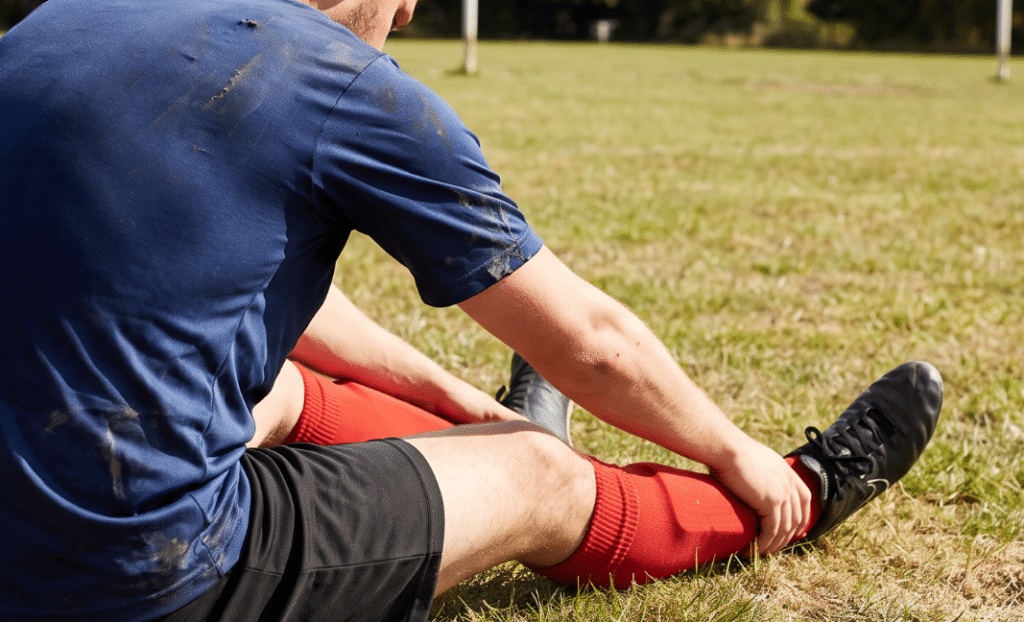
A rolled ankle on the football pitch and a runner’s sore knee after months of training look nothing alike, but both count as sports injuries.
The term covers a wide range of problems, from a single bad step to damage that builds up slowly over a season.
Knowing which type you’re dealing with matters.
Treatment for a sudden sprain looks very different to treatment for an overuse injury that’s crept up over weeks.
Here’s a guide to the most common sports injuries, what causes them, and how our sports massage and physiotherapy can help.
Sprains and strains
A sprain is a stretch or tear in a ligament, the tough tissue connecting bone to bone at a joint.
An ankle sprain is the classic example, usually from rolling the foot sideways during a change of direction.
A strain is the same kind of damage, but to a muscle or tendon instead of a ligament. Tendons connect muscle to bone, so a strained hamstring or a torn calf both fall into this category.
Both injuries range from mild to severe.
A grade one sprain might mean a few days of discomfort, while a full ligament tear can take months to heal properly.
Overuse injuries
Not every injury happens in a single moment.
Overuse injuries build up gradually, from the same movement repeated thousands of times over weeks or months of training.
Tendinitis is a common result, where repetitive movements irritate a tendon until it becomes inflamed and painful.
Achilles tendinitis and tennis elbow are two familiar examples. Achilles tendinitis takes its name from the tendon itself, while tennis elbow is named after the sport most linked to it.
A stress fracture is overuse at the bone level.
It’s a tiny crack that develops from repeated impact, most often in the shin or foot of runners.
Bursitis, inflammation of the small fluid-filled cushions around a joint, follows a similar pattern of gradual irritation.
Runners, cyclists and swimmers see more overuse injuries than sports built around single explosive movements. Their training repeats the same motion thousands of times a week.
A small technique flaw that’s harmless once becomes a real problem when repeated that often.
Joint injuries
A dislocation happens when a bone gets pulled or knocked out of its normal position at a joint.
Shoulders dislocate more often than most other joints, since the shoulder joint trades stability for a wide range of motion.
The rotator cuff, the group of muscles and tendons holding that joint together, often takes damage alongside a dislocation.
Twisting hard or taking a direct impact can tear the cartilage that cushions the ends of your bones inside a joint, especially in the knee.
The knee’s stability during sudden direction changes depends on the anterior cruciate ligament.
A footballer or skier who tears their ACL faces a long recovery, often the better part of a year. Surgery is common before rehabilitation can properly begin.
Fractures
A fracture is simply a break in a bone, though severity varies enormously.
Some fractures are hairline cracks that heal with rest, while others displace the bone completely and need surgery to realign it.
Rugby, football and other contact sports carry a higher fracture risk than endurance sports like running.
A direct blow or heavy fall puts far more force through a bone than everyday movement. A collarbone or wrist fracture is common after a fall from a bike or a tackle gone wrong.
Head and brain injuries
Concussion is the most common brain injury in sport. It’s caused by a knock to the head or a sudden jolt that shakes the brain inside the skull.
Symptoms range from a brief headache to confusion, dizziness or memory problems.
Any suspected concussion needs urgent medical attention before returning to play.
Head injuries are the one category in this guide where waiting to see if it settles isn’t the right approach.
What causes sports injuries
Some injuries happen in a single moment: someone lands awkwardly, two players collide, or a tackle catches a leg studs-up.
Others build from risk factors that stack up over time, like poor technique, fatigue, or jumping back into training too fast after time off.
Collisions make contact sports an obvious risk category, though plenty of injuries in non-contact sports like running or swimming come from overuse instead.
How sports injuries are treated
Treatment depends entirely on the type and severity of the injury.
Rest, ice, compression and elevation cover the first 48 hours for most sprains and strains, calming swelling before any other treatment starts.
From there, physiotherapy and sports massage takes over for the majority of sports injuries. A tailored treatment plan rebuilds strength and flexibility around the injury, rather than just waiting for pain to fade on its own.
Our physiotherapists check the injured area properly first. That might mean testing range of motion, strength, or how the joint moves under load, before any exercises begin.
The most severe injuries, a full ligament rupture or a displaced fracture, may require surgery before rehabilitation can even begin.
Getting it assessed by our physiotherapists early often means the difference between avoiding surgery altogether and needing it.
Sports injury questions answered
Are sports injuries more common in certain sports?
Contact sports like football and rugby see more sudden injuries from collisions, while running and swimming see more overuse injuries from repetition.
Can sports injuries be prevented?
Not entirely, but a proper warm-up, good technique, and exercise that builds up gradually rather than jumping straight to peak intensity all reduce your risk.
How do I know if my injury needs a physiotherapist?
Pain that lingers beyond a few days, swelling that doesn’t settle, or reduced movement in a joint are good reasons to get it assessed properly. Don’t just wait to see if it settles.
Is it ever okay to keep playing on a minor injury?
Sometimes, but it’s a judgement call best made after an assessment rather than a guess. A minor niggle ignored for a whole season can turn into a much longer injury.
Get your injury assessed properly
An injury that doesn’t add up, one that lingers, swells, or just doesn’t feel right, is worth getting checked properly rather than waiting it out. Guessing at what’s wrong rarely gets you back to full fitness any faster.
Whatever type of sports injury you’re dealing with, whether it happened yesterday or has been nagging at you for weeks, we’re here to help. Our sports injury rehabilitation team will assess it properly first.
From there, we’ll build a plan around your actual injury, not a generic one.
We want you back doing what you love, whether that’s running, football, or just getting through your week without wincing on the stairs.
Book online or call us on 07427 737 604, and we’ll get you sorted.
Book Your Appointment
Ready to take the next step? Book your appointment today or call us on 07427 737 604. We’re here to help with tailored, evidence-based care.