
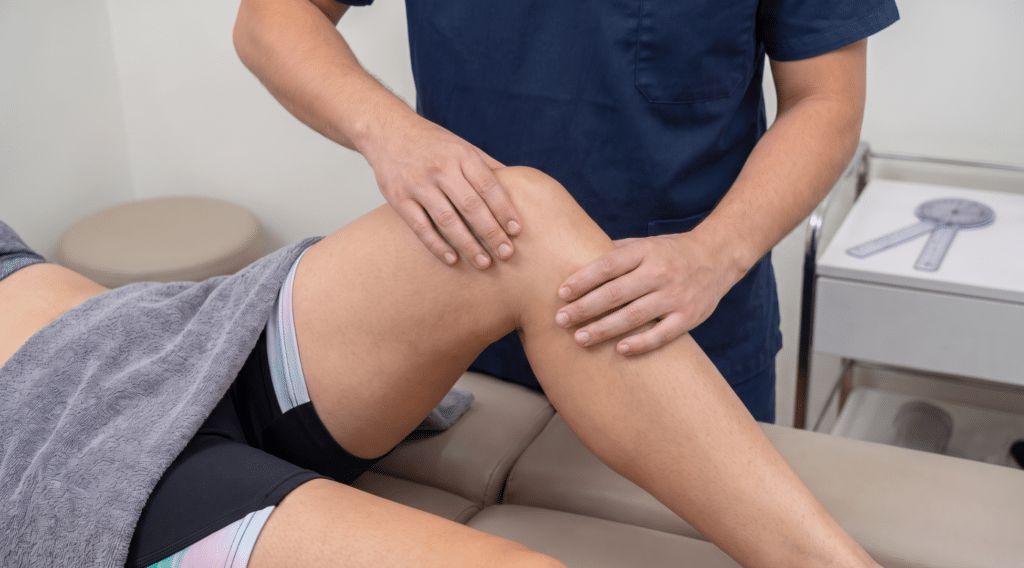
MSK stands for musculoskeletal.
Insurance paperwork and physiotherapy clinics use it for treatment aimed at your bones, joints, muscles and the connective tissue holding them together.
A stiff shoulder, a knee that clicks on the stairs or a back that aches on long car journeys: MSK physiotherapy treats all of it.
Below, we explain what it covers, what a session looks like, and how physiotherapy at Active Health Clinic Glasgow approaches it.
What “musculoskeletal” covers
Your musculoskeletal system is everything that lets you move: bones, joints, muscles, ligaments and tendons, plus the soft tissue wrapped around all of it.
Cartilage cushions your joints so bone doesn’t grind on bone, while ligaments hold joint to joint and tendons anchor muscle to bone.
When one part of that chain is damaged or overloaded, the rest usually compensates, and that’s often where pain starts.
A strained calf changes how you walk, which then loads your hip differently.
Spinal issues follow the same pattern, since the muscles either side of your spine work constantly to keep you upright.
Musculoskeletal conditions MSK physiotherapy treats
MSK physiotherapy treats musculoskeletal conditions across the whole body, from neck to ankle, not one joint or region.
Back pain and neck pain
Back pain is the one we see most, closely followed by neck pain from hours spent hunched over a screen.
Lower back strain from lifting or sitting badly falls into this same category, and sciatica often travels with it.
So does arthritis, where joint problems build up gradually, unlike a twisted ankle or pulled muscle that happens in a single moment.
Sport injuries
Sports injuries make up a big share of what we treat too, from a torn hamstring to a sprained ankle.
Not every joint condition is dramatic.
A frozen shoulder can stiffen until it won’t reach above your head, tennis elbow flares from repetitive lifting, and plantar fasciitis niggles after a run.
Chronic pain
Chronic pain that’s dragged on for months sits here as well.
It’s rarely one single injury and more often the accumulated effect of how someone moves, sits and trains.
What a physiotherapist does during treatment
A physiotherapist starts with an expert assessment, working out what’s wrong rather than just where it hurts.
That means questions about your symptoms, how they started, and what makes them worse.
The assessment also includes a physical examination, checking how far the joint or muscle moves and where that movement is restricted.
The assessment has to diagnose the problem before treatment leans on hands-on work, exercise, or both.
Hands-on treatment and exercise
Treatment tends to combine two things: hands-on techniques and a plan you carry on with yourself.
The hands-on side might involve manipulation or joint adjustment to restore mobility, plus soft tissue work where muscles have tightened up around an injury.
The self-directed side is a personalised exercise programme, built around your posture, your job and whatever sport or activity you’re trying to get back to.
Our holistic approach
We take a holistic approach at Active Health rather than treating the symptom in isolation.
A knee problem sometimes traces back to hip weakness, or a shoulder issue traces back to how someone sits at a desk all day.
We listen to your body’s needs and take your treatment from there.
Why musculoskeletal health matters
Joint stiffness and untreated strain rarely improve by themselves. They tend to spread instead.
Your body protects the sore area by changing how you move. That shift often loads a second joint or muscle until it starts hurting too.
Left unmanaged, minor issues can turn into long-term conditions that limit your quality of life for years.
A strain caught early usually needs a short course of hands-on treatment and a home exercise plan.
Left to become a chronic pattern, the same problem often needs a longer rehabilitation programme addressing months of compensatory movement elsewhere in the body.
Self-management matters for your wellbeing just as much as the sessions themselves do.
We’d rather give you tools you can use for years than have you back in the clinic every time a niggle returns.
What to expect at Active Health Clinic
Your initial assessment at Active Health starts with what you’ve tried already and what your goals are. No two patients need exactly the same plan.
Whether that’s getting back to five-a-side or sitting through a full workday without pain, we build your programme around it.
Our team is made up of HCPC-registered chartered physiotherapists, each with their own areas of focus. You’re matched with someone suited to your specific issue.
The specialist working with you has already treated cases like yours, from a straightforward strain to recovering from surgery.
Booking is straightforward too. You don’t need to see anyone else first.
MSK physiotherapy at Active Health is self-referral, so you can book directly with our team and get seen quickly, often within days.
MSK physiotherapy questions answered
What’s the difference between physiotherapy and musculoskeletal physiotherapy?
Physiotherapy is the broader profession, covering everything from respiratory care to neurological and orthopaedic rehabilitation. Musculoskeletal physiotherapy is the branch focused specifically on bones, joints, muscles and connective tissue.
What’s the most common MSK condition?
Back pain tops the list by a clear margin, followed by neck pain and shoulder problems. Most cases stem from posture, repetitive strain or a specific injury rather than anything more serious. Physiotherapy treats these well because the underlying cause is usually mechanical, not something needing further investigation.
Do you need a referral for MSK physiotherapy?
No. You can book directly with Active Health without seeing anyone else first. Just call or book online, and we’ll get you in for an appointment.
What does an MSK physiotherapy session involve?
Expect an assessment of your movement and symptoms, a working diagnosis, and hands-on treatment where it’s needed. You’ll also leave with specific exercises to do between sessions. Sticking to them at home speeds up recovery and lowers the chance the same injury flares up again.
Book an appointment with our MSK physiotherapy service
The longer a strain sits untreated, the more it may spreads to the joints and muscles compensating for it. Catching it early is usually the difference between a short course of treatment and months of rehab.
If pain or stiffness has been building for a while, book an appointment with our MSK service and find out exactly what’s going on.
No need for a GP referral.
Book online or call us on 07427 737 604 and we’ll get you booked in.
Book Your Appointment
Ready to take the next step? Book your appointment today or call us on 07427 737 604. We’re here to help with tailored, evidence-based care.